

Futures Thinking
Session 1.2
Introduction
| Definition: Future The future is the time regarded as “still to come.” The future can be seen as a realm of potentiality, where choices and actions shape what is to come. As a defining characteristic, the future is uncertain. The future is different from other temporal categories, namely the past and the present, as well as eternity, which stands outside time. |
Ray Amara (1981) defined three laws of futures:
- First, the future is not predetermined.
- Second, the future is not predictable.
- Third, future outcomes can be influenced by our choices in the present.
The third law of futures, as defined by Ray Amara, is a foundation for educating responsible leaders and the leading thought of this training: How can we ensure graduates are capable of embracing the opportunities they have, through their actions in the present, to make a difference for the future?
The ability to address futures is something that can be learned, practiced and developed. It includes a mindset and skill set with various methods created for working with the futures.
What, then, is Futures Thinking? And what about Sustainable Futures Thinking?
Start with watching this Introductiory video: What is Futures Thinking?
© 2019 Arizona Board of Regents for and on behalf of Arizona State University created by the Biodesign Pathfinder Center
Sustainable futures thinking and business education
As we anticipate growing challenges related to sustainability, it becomes clear that trends on a planetary scale—such as climate change, global warming, biodiversity loss, ecosystem degradation, resource exploitation, and scarcity—are likely to test our capacity to sustain functional and thriving societies while preserving a habitable planet. Concurrently, we must address persistent societal issues, including social inequalities, child and forced labor in global value chains, and ongoing state-based conflicts. There is an urgent need for a just transition toward a future that ensures a solid social foundation while operating within planetary boundaries.
Businesses are central to this transition. For business students, futures thinking offers tools to navigate complexity and uncertainty in global markets. In today’s rapidly evolving business environment, organizations are under significant pressure to align their strategies with sustainability goals, not just to meet regulatory requirements but to maintain competitive advantage.
Mastering futures thinking helps students to:
- Anticipate long-term environmental, social, and economic shifts.
- Rethink business models and value creation.
- Make better-informed decisions and plan across diverse scenarios.
- Integrate sustainability into strategy and operations.
(Wiek et al., 2011)
Envisioning alternative futures also strengthens innovation—essential for leaders addressing among others climate risk, resource pressures, and inequality.
Futures thinking equips business graduates to align near-term action with long-term sustainability under uncertainty. As educatoras we can prepare the next generation of business leaders to not only understand but actively shape the future of sustainable business practices.
“Our capability to think about the future manifests in our actions: our images and assumptions about the future influence our actions in the present, while our actions in the present contribute greatly to how the future begins to take shape.”
Pause and Reflect

Review your course and programme descriptions
* Do they address futures oriented themes?
* Are futures themes included explicitly and/or implicitly?
Sustainable Futures Thinking: an integrated competency
A competency-based approach integrates knowledge, skills, and mindset so learners not only understand the world, but help shape it. Futures-oriented competencies have gained traction with accelerating change and the UN Sustainable Development Goals (SDGs).
The literature uses overlapping terms for this capability:
- Anticipatory competence (Wiek et al., 2011; UNESCO)
- Futures thinking competence (Brundiers et al., 2021; KCSF)
- Futures literacy (Bergheim, 2024)
These terms differ in emphasis more than substance, are often used interchangeably, and are best seen as complementary. Common elements across definitions include the capability to:
- Acknowledge multiple futures and potential developments.
- Recognize the future is not predetermined; today’s decisions shape it.
- Use visioning and imagination to explore alternatives.
- Craft, analyze, and evaluate futures for feasibility, desirability, and sustainability.
- Engage futures work as a collective endeavor.
- Apply the precautionary principle, assess consequences, and manage risk and change.
From competencies to practice
Within key sustainability competencies, a critical dimension is crafting rich pictures of the future for specific issues and anticipating how challenges may evolve over time (Wiek, 2011). In practice, this often means building development pathways—scenarios that contrast desired change with “non-intervention” or business-as-usual trajectories.
These exercises are value-laden and action-oriented, and require deep systems understanding. Thus, futures thinking competence draws on multiple capabilities. Beyond visioning and systems thinking competences, it relies on normative competence to address ethical, cultural, and political questions about what counts as “desirable.” When educators guide students to imagine a sustainable future world, they teach students to see interconnections of systems and subsystems, negotiate value trade-offs and connect aspirations to strategies.
Recognizing the power of these competencies in shaping real-world outcomes, we suggest referring to this integrated approach as Sustainable Futures Thinking—to emphasize the ethical and ecological imperatives at its heart.
Temporalities of futures
Time matters in futures work. The future has been described as the “not yet” (Adam & Groves, 2007). The immediate follow-up question is “when?”
We can distinguish between many different temporal dimensions of futures and different questions call for different horizons.
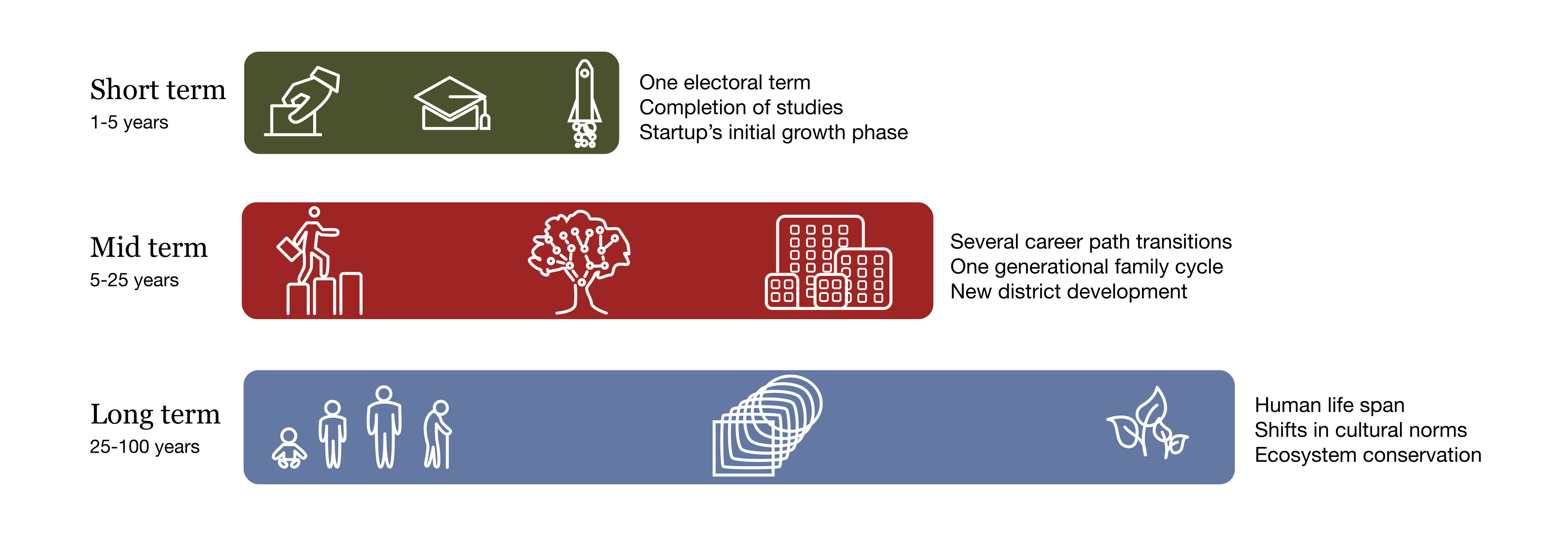
Each timeframe has value depending on context and perspective. We need to match horizons to the question at hand, and pair long-term thinking with attention to history and memory. Both shape what futures are imaginable and actionable — by revisiting the past and assigning new meaning to it, we can better inhabit the present and open space and possibilities for unknown futures (Söderbäck, 2019).
We should critically examine whose histories and memories are visible in everyday life, the public sphere, business, and historical writing. It is also important to recognize how these narratives influence our sense of time and development—as individuals, communities, regions, and nations.
In higher education, short- to medium-term planning often dominates. Yet sustainability challenges—climate justice, biodiversity loss, and intergenerational equity—require sustained engagement with the long term.
Pause and Reflect
What time spans do you consider most significant
* in your professional role as a teacher in higher education?
* in the business field your teaching addresses (e.g., finance, international business, supply chains)?
* in solving global sustainability challenges addressed in the SDGs?
Explore further

Futures Glossary
A multilingual collection of key terms frequently used in the futures field. https://futuresglossary.net/
Linking Competencies: Radical Creativity for Futures Thinking Eloranta, Hakanen & Shaw (2024). Teaching for paradigm shifts: Supporting the drivers of radical creativity in management education. Educational Research Review 45:100641