

Multiple Futures
Session 2.2 – Explore
“Any useful idea about the future should appear ridiculous”
James A. Dator
The aim of this section is to show how multiple futures can be conceptualized and categorized. Categorizing multiple futures clarifies how likely, credible, and desirable different paths are.
Multiple futures: core categories
Multiple futures can be organized by their epistemic status and uncertainty. Common categories include:
- Potential: Futures that extend beyond the present—everything that could unfold from now.
- Probable: Futures likely to happen, often inferred from current trends. What is most likely?
- Plausible: Futures that could happen given current knowledge and how the world works. Based on current trends, what could happen?
- Possible: The widest set of futures, including low-likelihood “wild cards.” What might happen beyond current expectations?
- Preferable: Futures that individuals or groups want or prefer to happen, based on subjective values. What should happen? Note: Also the opposite of desirable is important to explicitly distinguish. Non-preferable or feared futures are those we do not want.
- Preposterous: Futures deemed impossible or unthinkable today. What is unthinkable now but might become necessary?
- Projected (Business as Usual): The default future, the extrapolated baseline if nothing significant changes. Where are we heading if nothing changes?
Being able to identify and distinguish multiple futures—including separating probable from desirable futures and reflecting critically on their use in management—forms part of futures thinking competence (Bergheim, 2024; Wiek, 2011).
Understanding epistemic status
- Probability estimates how likely a scenario is based on available data and models. In the sustainability context, probability supports policymakers and organizations make more informed decisions on prioritizing resources and mitigating risks. The practical challenge is balancing desirability with feasibility. It is not just about creating a future that works but about making choices that lead to a more sustainable outcomes.
- Plausibility assesses whether a scenario makes sense given logical reasoning and existing knowledge, even if it is not likely. For example, full ecosystem restoration may be plausible conceptually but unlikely given current degradation and scale.
- Desirability reflects individual or societal value judgments about preferred futures. In sustainability, desirable futures align environmental, social, and ethical goals—for instance, protected ecosystems, reduced inequality, and sustainable resource management.
On preposterous futures
Some futurists argue that preposterous futures are crucial. Those futures that seem impossible are genuinely new and stretch thinking beyond conventional paths. “Some of the most important changes in human society and history have arisen from things thought to be totally preposterous” (Voros, 2015).
Example

Over five generations (1900–2020), life expectancy for a baby girl in Finland rose roughly 40 years —from about 45 to 85. At the turn of the twentieth century, many would have called that preposterous; yet it happened.
Pause and Reflect

* Can you think of other seemingly preposterous developments from the past?
The Futures Cone
The Futures Cone is a widely used framework for visualizing and comparing multiple futures. It is a cone‑shaped diagram that can be used as a descriptive tool to visually represent the variety of potential multiple futures. (Voros 2003; 2017; Gall et al., 2022)
The cone shows how the space of possibilities expands as we look further ahead, and how judgments about possible, plausible, and probable evolve with time and new information, when current knowledge and trends develop and new events or technologies emerge. The cone also supports temporal thinking: what seems impossible today may become plausible tomorrow (Voros, 2017).
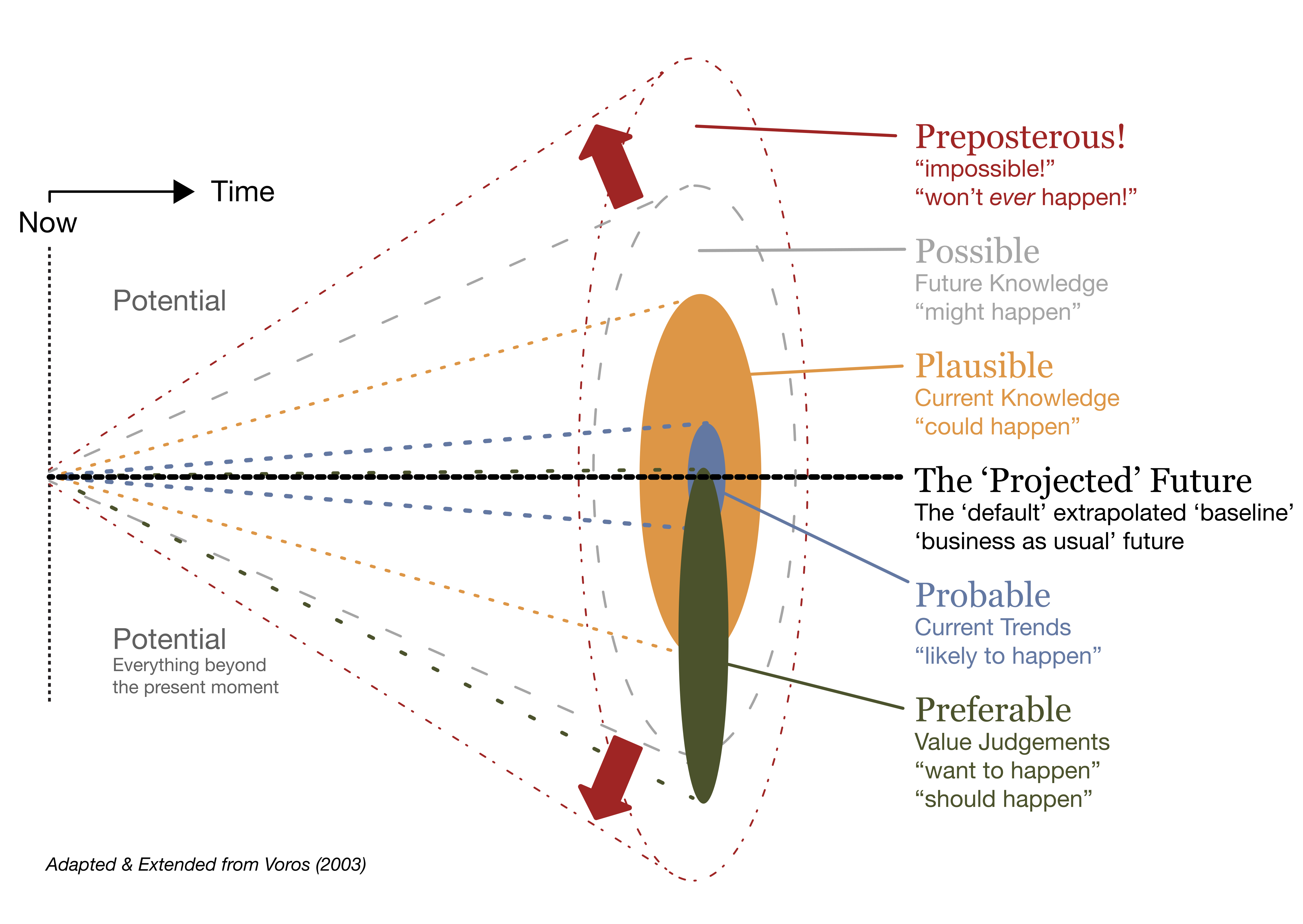
The Futures Cone can be used as a tool in various contexts and time frames. Let’s take an example of ESG reporting and explore. Different scenarios can be created and then mapped with the Futures Cone. The different futures might look like this:
Probable Future (likely to happen)
ESG reporting includes expanded mandatory disclosures with limited but growing assurance, supported by better Scope 1–2 data quality and rough, spend-based Scope 3 estimates. Reporting relies on spreadsheets and BI dashboards on a periodic cadence, supplemented by supplier questionnaires collected through portals. Basic carbon accounting is integrated into resource planning systems.
Plausible Future (next-wave shifts that could reasonably happen)
In its ESG reporting, an organization maintains limited reasonable assurance on key metrics such as GHG and energy with standardized audit trails, uses activity- and meter-based data for Scope 2 and category-specific models for Scope 3 (e.g., Categories 1 and 11), and facilitates supplier data exchange through common schemas with incentives to improve response rates. Satellite and IoT data support verification for issues like deforestation and methane, with automated hotspot flagging, while double materiality assessments are embedded in risk management and board-level KPIs are linked to executive pay.
Possible Future (disruptive but credible, might happen)
An organization operates near–real-time emissions dashboards with automated meter and telemetry ingestion across the value chain, delivers product-level carbon footprints and Digital Product Passports that travel with goods, and provides customer-level reporting on use-phase emissions. Environmental attributes are tokenized and traceable via high-integrity registries to support fraud-resistant offsets, while AI agents reconcile conflicting data sources and estimate missing supplier data with confidence intervals and full auditability. Verified ESG metrics drive litigation exposure and tariff decisions, reshaping sourcing choices virtually overnight.
Preferable Future (should happen)
An organization delivers decision-grade, assured ESG data on par with financial reporting in a single integrated report, featuring high-fidelity, activity-based Scope 3 coverage and targets aligned with 1.5°C and just transition principles. Disclosures are transparent, comparable, and interoperable, while inclusive supplier enablement—through tooling, financing, and training—helps SMEs report reliably. The focus is impact-first, with verified, continuously improving outcomes across emissions reductions, biodiversity gains, safe workplaces, and equitable pay. The preferable future includes a fundamentally normative, value‑based dimension.
Pause and Reflect
* How would a preposterous future of ESG reporting look like?
* How would you describe an undesirable, unsustainable future of ESG reporting?
Non-preferred Future (should not, must not happen)
Regulatory fragmentation fuels checkbox compliance across conflicting frameworks, raising costs without improving data quality, while greenwashing or greenhushing erodes investor and customer trust. Perverse incentives drive divestment, supplier shuffling, and the exclusion of high‑emitting SMEs and Global South vendors instead of enabling real decarbonization. Low‑integrity credits and book‑and‑claim abuse substitute offsets for abatement, enabling double counting through opaque registries. Narrow KPIs encourage metric gaming—apparent reductions via boundary changes rather than operational improvements—while a Scope 3 stalemate persists with poor data sharing, entrenched spend‑based estimates, and ignored uncertainty. Social harms continue as weak detection of labor violations turns audits into “assurance theater,” and data risks—siloed, unverifiable, or breached ESG systems—create privacy and IP concerns that deter supplier participation. Meanwhile, escalating climate risks from severe weather, deforestation, and biodiversity loss go unaddressed by backward‑looking disclosures.
Pause and Reflect
Think about the future of business education
* What features do you consider probable, plausible, and possible in the future of business education?
* What about your own disciplinary specialization area?
* What futures do you consider preferable?
* Are there signs of directions of non-preferred futures of business education?
You can now deepen your understanding of multiple futures with a perspective to questions around diversity, equity and inclusion. What do they have to do with multiple futures?